Introduction
 |
 S
strange as it might
seem, psychology really cannot say much about human sexuality. It’s true that
psychology can be used to treat sexual dysfunction, and psychologists know
that coerced sex, such as child abuse or
rape, leaves lasting emotional scars on the victims. But
psychology really cannot offer much advice to consenting adults as to what sexual
activities are appropriate or inappropriate. Not much, that is, except this: You
can get into all kinds of trouble if you fail to understand something about the
nature of perversion and love. S
strange as it might
seem, psychology really cannot say much about human sexuality. It’s true that
psychology can be used to treat sexual dysfunction, and psychologists know
that coerced sex, such as child abuse or
rape, leaves lasting emotional scars on the victims. But
psychology really cannot offer much advice to consenting adults as to what sexual
activities are appropriate or inappropriate. Not much, that is, except this: You
can get into all kinds of trouble if you fail to understand something about the
nature of perversion and love. |
Perversion
|
Perversion. This is a word not heard much in today’s
world. The verb to pervert literally means “to lead astray”
or “to misdirect,” and perversion usually is used in the moral
sense to refer to something that leads a person away from what is good or
right. But I will be using the word in the psychological sense of something
that leads a person away from a psychological
goal.
As an example,
consider the nature of alcohol abuse. Psychologically speaking, alcoholics
drink in order to avoid the pain of facing up to and making amends for all
the times they have failed to take responsibility for their lives. Hence
the
abuse
of alcohol can be called a perversion because it leads a person away
from the true aim of dealing with the
guilt
and into a drunken state of illusory well-being.
To be clever,
we could say, then, that the point of a perversion
is to always miss the point.
With more direct
language, we can say that a perversion leads you away from the true depths
of your emotional pain—and from the psychological healing that could
happen if you were to work therapeutically with that pain—by distracting
you with something apparently pleasurable.
The connection
between sex and perversions is found in love. But when talking about love
we need to be clear what we are really talking about. |
Courtly
Love
|
If you study the history of human sexuality and marriage
through ancient and primitive cultures, you will find that communal sex and
polygamy predominate. Communal sex tends to predominate in matriarchal
societies—that is, societies in which power tends to pass through women,
and property is more or less communal—where women mate with whomever
they want, without any particular, or lasting, emotional
attachment.
In patriarchal
societies, where property passes through the male lineage, knowing a
child’s father is of greatest importance; hence men tend to be promiscuous,
while women are carefully guarded sexually.
And then there
are those curious mixtures of elements, such as in cultures where a man would
offer his wife for the night to a guest, as a token of
hospitality.
Yes, there are
occasional stories, some very poetic—and tragic—about a man and
a woman, each promised in an arranged marriage to someone else, who became
passionately attracted to each other. But, as with most things in life, these
exceptions only prove the rule: through most of human history, about the
only thing that hardly ever seemed to influence mating was romantic
love.
Yet, when individuals
in Western cultures think about “finding a mate” they tend to think
of romantic love. And one of the most enduring images of romantic love is
the medieval knight in shining armor, the strong but pure man who rescued
the lady in distress . . . and they lived happily ever after.
In reality, most
medieval knights were anything but pure, and “marriages,” as in
pagan cultures, lasted only as long as convenient. If you read medieval history
carefully, you will find that European feudal society, especially under the
influence of the Albigensians in the 11th to 13th centuries, was barbarian
and chaotic, rife with murder, massacre, and cruelty. Knights, if they were
anything, were nothing more than thugs and rapists who preyed upon any
defenseless persons they came across. The knightly sexual ideal was to seduce
a married woman, and, if she refused, to rape her. The literature of this
“age of chivalry” essentially idealized adultery.
“Wait a
minute,” you say. “That’s not what I learned about courtly
love. Courtly love was pure and ideal. So what happened?”
Well, the troubadours
and their Provençal poetry
“happened.”
In the
later middle ages, the troubadours, under the influence of Christianity,
transformed an old literature based on hedonism into a new
European literature based on the idealization of
love.[1]
Thus the knights went from lusting after their
friends’ wives to swooning in love over a woman’s glove. The literature
idealized “love” to such an extent, and set so many obstacles in
front of it, that this love became almost impossible to attain. And
so romance became a poetic quest for an unattainable ideal of
wholeness.
The aristocracy
upheld this ideal of courtly love on the surface—while doing what it
wanted behind the scenes, of course—and it provided the underlying European
moral influence for the masses, for the last several centuries. Consequently,
bolstered by Hollywood cinema in the 20th century, romantic “love”
became the obsessive secular quest of life in the Western—and
Western-influenced—world. And then, with the collapse of sexual morality
beginning in the 1960s, the final transformation was made: the long sought chalice
of courtly love was filled with erotic
sexuality; that is, lust.
Notice, however,
that this courtly “love” is not a pagan concept, and, though it
was influenced by Christian morality,
 it has nothing in common with real Christian love either.
Like the famous quest for the Holy Grail, courtly love is a medieval literary
creation. it has nothing in common with real Christian love either.
Like the famous quest for the Holy Grail, courtly love is a medieval literary
creation.
Which is
why the brilliant French psychoanalyst, Jacques Lacan, declared that courtly
love “is an altogether refined way of making up for the absence of sexual
relation by pretending that it is we who put up an obstacle to
it.” [2]
In other
words, the chalice of courtly love—and all the romantic sentiments and
eroticism that fill it—is an
illusion.[3] It’s impossible to find love through sexuality.
It’s impossible to use your body to hide your emotional pain.
It’s impossible to heal your own emotional brokenness through
the body of another person as mortal and broken as you
are. [4]
|
This absence
of a sexual relation, as taught by Lacan in his psychoanalytic concept of
the impossible, can be approximated by
the old Zen question, “What is the sound of one hand clapping?”
For example, I have seen both men and women who have tried to seduce a woman
to get from her the nurturing and attention they never received from their
mothers. And I have seen both women and men who have tried to seduce a man
to get from him the protection and attention they never received from their
fathers. And in the end it’s all an impossibility. The moral is simple,
and cuts across the board, male and female, heterosexual and homosexual:
You can never seduce your despair, and you can never
find real love through any form of sexual activity.
Thus, one does not need a “sex life” to be a good person. Notice,
though, that a good person is not the same as a good citizen.
A good citizen is a spiritually empty, insatiable consumer, and, because of
the efforts of the advertising and entertainment industries, lust has become
a prime consumer activity. So let’s give a round of applause to those
industries Ah, can you hear it—the pathetic sound of one hand
clapping? |
|
|
Real
Love
|
Most persons don’t realize this,
but the common, or popular, view of “love” involves an element
of receiving something. “I love chocolate” really means
that “I enjoy getting the experience of the taste of chocolate.”
Similarly, “I love you” commonly implies “I enjoy playing
with your body,” or “I enjoy believing that you will give
me security or protection,” or “I enjoy feeling sexual pleasure
with your body” (or “I want to have sexual pleasure with
your body.”) As a result, Lacan, in his teachings about love, described
the typical act of love as “polymorphous
perversion.” [5]
Don’t be
put off by the big words. You already know what perversion means.
Polymorphous simply means “having many forms.” So this amounts
to saying, like the popular song from the 1980s, that we’re looking
for love in all the wrong places. That is, we look for satisfaction in all
the various titillating parts of the body but never find what is truly
sought.
What is “truly
sought” is something we all experience as painfully missing from life:
some comforting sense of absolute belonging and acceptance. Those who are
fortunate get a sense of this feeling as babies, under a parent’s
protection, although the feeling is fractured more often than not by ordinary
parental empathic failures, and then it is lost entirely as children become older
and independent and the awareness of their essential human isolation and mortality
sets in. Those who are less fortunate suffer a deeper lack: some parents are
emotionally or physically distant and rarely provide any comfort and acceptance
to their children; and some parents are outright abusive,
leaving their children to languish in an environment of criticism and neglect.
|
Suffering from the lack
of parental acceptance, some people skip from one “partner” to another
over the surface of existential pain, like a stone skipping over water. As long as
they stay above the surface they’re perfectly happy; but when an affair ends,
and they come crashing down, they’re desperate for the next leap, sometimes
searching for a new partner even at the funeral for the old one. Yet sooner or later
the stone loses vitality, and with a final splunk falls into the depths of
tribulation. |
|
Lacan points
out that although “love”—that is, in its common, popular
sense—is, in essence, a futile chasing after something that doesn’t
exist, there is nevertheless a love beyond this “making love,”
a love that exists beyond lack and limitation and that involves a sort of
ecstasy of
being,[6]
as a matter of
soul,[7]
not of the body. The irony is that in the common
act of “making love” we think we know what we want, but
it turns out to be an illusion, while this other love touches on a real
experience of which we know nothing. It’s a mystical sort of
thing, as Lacan
acknowledges.[8]
Now, although
Lacan doesn’t say it this way, the difference between these two kinds
of love—common “love” and true love (or real love)—can
be conceived of as the difference between receiving and giving.
|
Note carefully,
though, that giving does not refer to the mere sharing of material
objects or wealth; it refers to the expression of profound emotional qualities
such as patience, forbearance, compassion, understanding, and
forgiveness.
This all goes to show that it’s easy enough to “love” those
who “love” us: parents who protect us, “partners” who
make us feel received, animals who never threaten us. But can we love those
who annoy us . . . irritate us . . . obstruct
us . . . scorn us . . . hate us? Can we love
our enemies? That’s the real test of real love. |
|
And it was out
of a true understanding of the difference between common “love”
and real love that a man such as St. Francis of Assisi
was led—led right to the point, actually—to pray that he might
seek “not so much to be loved as to
love.” |
Imitations
of
Real
Love
|
As shocking as it might
sound, most of us who claim to be loving are not giving selflessly. Instead,
we are addressing a covert psychological desire either to avoid being
abandoned or to feel powerful.
“Love”
as Bribery
Most men who
give flowers to women, for example, are either saying, “I desire to
use your body for my erotic pleasure,” or they are trying to satisfy
the woman’s demand for recognition—and to avoid her
anger and rejection if the recognition is
forgotten—on a birthday or anniversary.
Similarly, many
parents who give excessive money or presents to children or grandchildren
are unconsciously trying to buy allegiance and favor. Unable to accept and
understand the child’s deepest emotional experiences, the parent will
offer an easily procurable object to make the child feel happy. And the child,
unable consciously to express the covert cover-up occurring under his or
her very nose, will accept the present under the assumption that “this
must be love.”
Sad to say,
therefore, the apparent generosity of common “love” is really an
act of bribery.
“Love”
as Power
We commonly believe
that the desire to erotically arouse another person is a sign of love. The
deep psychological truth, however, is that such a desire masks a more hidden
desire: to manipulate someone because you have been manipulated by others. That
is, because you as a child felt the helplessness and resentment of being emotionally
and physically manipulated by your parents, as an adult
you will unconsciously compensate for this helplessness by seeking out ways to
manipulate others. You will do this because we all do it. We can do this with wealth,
we can do this with education, we can do this with social status, we can do this
with physical strength, and we can do this with lust.
Sad to say,
therefore, the thrill of arousing lust in another person is really an act
of self-serving power over that person.
|
Child abuse,
too, is a form of power over another gained through common “love.”
But whereas most common “love” takes the form of willing manipulation,
child abuse is coercive: the abuser preys
upon a child’s moral and intellectual helplessness. The abuser gets
all the self-satisfaction he or she wants and in the process leaves the child
with a life-long emotional scar of having been exposed to the manipulative
aspects of eroticism well before having developed healthy
defense mechanisms to cope with such psychological
assaults. The abuser walks away smacking his lips, and the child is left
as bones for the garbage. |
|
Summary
Therefore, those
who have the most to gain have the greatest desire to deceive. Those who
have the least to gain—and who want nothing, and who give everything,
like the saints—can love perfectly. And this perfect, real love is no
imitation.
|
Most persons
today will say, “Oh, come on. As long as I love my sex partner, it’s
OK.” Yet consider all the orphaned children around the world whose
parents—now dead—became infected with AIDS while saying “I
love you.” So does saying I love you make it OK? |
|
|
Fear
of
Love
|
Believe it or not, most of us are brought up in modern
culture to fear love. This is a radical statement, so pause a bit and consider
it.
How often were
your deepest human needs for comfort, protection, and guidance as a child
ignored or stifled by your parents? How often were you, as a child, criticized
and laughed at for expressing your
honest
feelings? How often are you now used, in our culture of merchandising, as
an object to be manipulated in order to satisfy some other person’s
desire for profit and power? How often do you
shape
yourself—with fad diets, implants, cosmetic surgery, workouts, jewelry,
tattoos, makeup, hair dye, and clothing—to meet the expectations of
someone’s desire?
And how often,
in the midst of all this exploitation, has anyone ever done anything for
your own growth and welfare, without thought of what could be had in
return?
So what does
a person learn from such experiences other than that this is a world of
competition, strife, and conflict, geared toward the survival of the
“fittest”—or in today’s world, the
meanest—in which honesty and compassion are foolish
weakness?
Is it any wonder,
then, that when denied the comfort and respect of real love, the fear and
panic can be so blinding that children will blame themselves, believing that
they don’t deserve love, and will fall headlong into self-loathing and
masochism?
In contrast,
real love is an act of will, not something that you “fall” into.
You can fall into desperate desire, and you can fall into fatal attraction,
but you can’t fall into love. Love is not a feeling. Love is a sacrifice
of sorts, and it’s a sacrifice of all the illusions that our culture
expects from us. To offer real love—to wish good to
someone [9]—is to stand against the culture—not as a
revolutionary or
terrorist,
but with a humble offering of understanding and compassion, something better
than what others “see” in their
blindness.
True love, therefore,
forsakes the prestige offered by the culture in its illusions. Yet, when
we have been taught from childhood to covet this prestige as our very
identity,
is it any wonder that we fear love?
Far easier—and
safer—isn’t it, to hide behind illusions and games of wealth, power,
violence, intrigue, and seduction? |
The
Love-Hate
Flip-flop
|
One of Sigmund Freud’s early disciples, Melanie Klein, took
up the task of applying the techniques of psychoanalysis to children. She
considered her work a natural extension of Freud’s theories, rather
than any sort of innovation in psychoanalysis; still, she met considerable
criticism from her psychoanalytic colleagues. And rightly so, for her work
is characterized by speculative and fantastic explanations of, well, infant
fantasy.
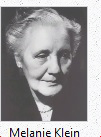 Nevertheless, Klein did
bring to light the “ugly” side of infant development, for she saw
in infants a mass of angry and hostile impulses toward the mother when the
infant did not get its needs met. In essence, the infant constantly flip-flops
between love and hate: love when its needs are met, and hate when its needs
are ignored or frustrated. In her work, Klein tried to explain the process
by which the infant seeks to repair the damage of its hostility to its mother.
In fact, the titles of two of her most significant collections of works,
Envy and Gratitude and Love, Guilt, and Reparation, tell the
story almost as well as the writings themselves. Nevertheless, Klein did
bring to light the “ugly” side of infant development, for she saw
in infants a mass of angry and hostile impulses toward the mother when the
infant did not get its needs met. In essence, the infant constantly flip-flops
between love and hate: love when its needs are met, and hate when its needs
are ignored or frustrated. In her work, Klein tried to explain the process
by which the infant seeks to repair the damage of its hostility to its mother.
In fact, the titles of two of her most significant collections of works,
Envy and Gratitude and Love, Guilt, and Reparation, tell the
story almost as well as the writings themselves.
Ultimately, though,
Klein’s theories—through their influence on the subsequent
psychoanalytic theory called object relations—can lead to a grave
error in psychological treatment, for they tend to make the psychotherapeutic
process a dyadic process between the psychotherapist and client. At its worst,
this makes psychotherapy into a mothering process of caring for the needs
of the client, and it reduces the “therapist” to a paid
friend—or
nanny.
Lacan saw
through these errors and taught that psychoanalysis must involve three
persons: the client, the analyst, and the
unconscious.
Just as healthy emotional development depends on a father coming between
the mother and child, to sever the child’s emotional enmeshment with
the mother, good psychotherapeutic work must let the unconscious come between
the client and psychotherapist. This means that the psychotherapeutic process
must always involve a symbolic
fathering [10] by which clients are led to recognize and overcome the illusions
of their unconscious
identifications
with others and, in the process, to heal the aggression and
hostility that underlie those
identifications.
|
This explains
why “lovers,” friends, and blog readers, with all their personal
needs and desires, cannot function psychotherapeutically. And it explains
philosophically—above and beyond any laws or professional ethics—why
psychotherapists cannot be friends or “lovers” to their clients.
If they try, it will lead to psychological disaster, for without the third
person of the unconscious in the consulting room the psychotherapy can
degenerate into all sorts of perversions. |
|
And, of course,
this all explains the ultimate “kink” in human sexuality: the love-hate
flip-flop.
As unpleasant
as it may be to admit it, eroticism is based on infantile needs to be received,
accepted, and satisfied. When a person feels intensely received, accepted,
and satisfied, then he or she is “in love.” But sooner or later
that intensity will be broken. The break doesn’t even have to be the
result of malicious neglect; it can simply be the result of a need to attend
to other obligations in the world, and, in the person feeling neglected,
intense jealousy can flare up.
|
Often people
fear that someone or something they love will be stolen from them by someone
else. But in real love there is no jealousy. When you have nothing to lose,
and nothing to gain, how can you fear a “rival”?
But, because romance is not based in real love, romance is, in technical
psychological terms, a game—and in playing this game, you put yourself
in competition with everyone else playing the same game. This explains the
essence of jealousy: in your fear of losing what you desperately want,
you hate any person who might come between you and what you want. |
|
So, regardless
of how it happens, as those primitive needs are not met, then the
“love” flip-flops into hatred and aggression. If you don’t
believe it, take a look at the ugly process of our divorce courts for a perfect
example. The world is cluttered with broken relationships that began in sweet
love and ended in bitter anger and hate.
And all of this
proves that real love, which is based in giving, not receiving, is pure and
eternal, is never fleeting, and can never flip-flop into hate.
It’s just
a shame that real love—the only true reparation—is feared by most
families and is hardly ever taught to anyone, children or adults. |
Abusive
“Lovers”
|
A client suffering in an
abusive relationship will often look up
through streaming tears after describing the abuser’s behavior and say
to the psychologist, “But I love him.”
Fair enough,
you might think. Offer love in spite of the abuse. After all,
aren’t we told since childhood to “Do to others as you would have
them do to you”? Isn’t that what love is?
Well, it is true
that many saintly individuals have patiently suffered through difficult
marriages. But saintly individuals do not need psychologists. If the abuse
gets violent, police protection may be needed, but no one who understands
real love will ever have to sit in front of a psychologist offering
excuses.
Excuses serve
to justify repeated behavior. And, as Freud discovered,
repetition
is the return of the repressed. What, then, is this repressed which
keeps getting repeated? It can’t be love because real love can never
be repressed.
The repressed
is desire, and in abusive relationships it is a desire often hidden
in plain sight. It’s the desire to receive what you are futilely trying
to give away. It’s the desire to be wanted. And it’s such
a desperate desire that you will suffer almost anything—from one failed
“lover” to another—to maintain the illusion that someone wants
you.
To bring this
illusion to light, just consider the case of a person “involved”
with an abusive “lover.” Then
ask this question: If you weren’t having sex with her or receiving monetary
support from him, would you still stick around? If the answer is
“No,” then you have the lie in plain sight. And if the answer is
“Yes,” then why not take in every bum in the neighborhood and be
a real saint?
So there you
have it. “But I love him” really means you don’t understand
love at all. |
Sexual
Addiction?
|
If you look in the
DSM-IV,[11]
you can find a Sexual Desire Disorder called
Hypoactive Sexual Desire
Disorder which refers to “deficient
(or absent) sexual fantasies or desire for sexual activity.” The fact
that the DSM-IV does not have a Hyperactive Sexual Desire Disorder
says quite a lot about our culture. Apparently, we seem to believe that
“not enough” is a bad thing, but “too much”—at least,
in regard to sex—is never too much.
Nevertheless,
some persons are troubled by their sexual desires, especially when they involve
masturbation or other forms of sexual activity. Consequently, the term sexual
addiction may be used, but it is really just a politically correct way to
make it seem that sexual behaviors are matters for medical oversight and control
rather than matters of personal responsibility. The truth is, you seek your
identity in sexuality because you have been duped by society into believing that
sexuality has the power to redeem your emotional emptiness.
You have
been duped especially by the entertainment industry, an industry that has
worked subversively through movies and television to glamorize the image
of lust in our culture. For example, it may seem on the surface that
“the woman” has been idealized, but the underlying
motive has been to defile the feminine, stripping the female body of its
dignity and reducing it, often with violent overtones, to a soulless sex
object.
Psychologically,
all this fascination with lust has its roots in the emotional emptiness that
a person wants to push out of awareness with the illusory thrill of intoxication.
This intoxication doesn’t have to be chemical—lust, gambling, and risk taking can
all provide a “high.” Why else would we talk about any kind of
arousal as getting “turned on” by
something?
|
In the
1950s, psychological researchers began to experiment with the intensely
pleasurable effects of electrical stimulation of the brain on animal
behavior.[12]
One
study [13]
allowed rats to press a lever that stimulated the
pleasure area of the hypothalamus; the rats pressed the lever continuously,
several thousand times per hour, even to the point of collapsing from fatigue.
Another
study [14]
found that female rats would even abandon their
own newly born pups for the sake of the brain
stimulation. |
|
And so it is
with erotic pleasure. The psychological problem with the intoxication by
real or imagined sexual stimulation, therefore, is that the pleasure becomes
an end in itself.
In the clinical
setting, many persons in psychotherapy will confess that, in their childhood
and adolescence, they lacked a clear sense of what they wanted to do with
their lives because they did not experience real love and guidance from their
parents. As a way to cope with the frustration of being overwhelmed by
the obligations of a life to which they didn’t feel any commitment in
the first place, they turned to a preoccupation with any stimulation divested
of any responsibility or commitment. Thus they got caught up in the euphoria of
a meaningless quest for a lost meaning to their
lives.
Thus pornography
takes on the excitement of the search for a stimulating
image. Dating takes on the excitement of the search for a stimulating body.
Masturbation takes on the excitement of the search for stimulation itself.
But it’s all an impossible quest for the real love that a mother and
father failed to provide.
|
Now, some persons
might try to justify their unconscious quest by saying that erotic pleasure
is “natural.” That’s the underlying philosophy of the Marquis de
Sade’s writings, for example. Consequently, his name—de Sade—
provides the origin of our word sadism. It all comes down
to saying, “Any body—man, woman, child, or animal—is
as good as any other body. Anything goes—even someone’s pain—if
it serves your pleasure.”
So there’s the “natural” for you.
Moreover, like all natural disasters, lust leaves nothing in its path but
destruction—a barren swath of sadistic or masochistic emotional
destruction. |
|
Sadly, in its obsession
with erotic pleasure our culture doesn’t want to see the human destruction it
causes. Actually, as long as you’re intoxicated, you can’t
see it. As a result, instead of taking personal responsibility
to detach yourself from social illusions, you
willingly consume them. You have been duped into believing that you can use
your own body to heal your emotional despair. It’s not an addiction
that troubles you, it’s your belief, through cultural brainwashing, that the
meaningless quest for lost meaning has meaning.
|
Speaking of
intoxication, some persons wonder what effect alcohol has on sexual desire.
Well, actually, it has no effect. Alcohol simply deadens the inhibitory function
of the frontal lobe of the brain. So while the frontal lobe is trying to
tell you, “Stop! This isn’t right!” the intoxicating effect
of alcohol intercepts that message and substitutes its own subversive message:
“Hey, if it feels good, do it.” |
|
|
“Victimless”
Sex
|
I have seen parents who say to their children, “If
you are going to smoke, I don’t want you smoking in the house. If you
are going to drink alcohol, I don’t want you to bring alcohol into the
house. If you are going to have sex, I want you to use protection. If you
are going to have your boyfriend stay overnight, I want to see him sleeping
on the couch in the living room when I get up in the morning. If you have
a car accident, I want you to get it fixed yourself.” And then they
turn to me and say, “See? We’re teaching our children
responsibility.”
The parents glow
with an air of self-satisfied serenity, but in reality,
they’re like the eye of a hurricane, calm and peaceful, blind to the
storm spreading moral chaos all around them.
And this
“serenity” is the attitude behind a tolerance for
“victimless” sex.
“What’s
wrong with pornography or prostitution? As long as no one gets hurt, no harm
is done,” we say.
But is it true
that no harm is done? Maybe, like the parents in the example above, we just
don’t want to see it. Maybe we don’t want to see the corruption,
the fraud, the theft, the abuse—the murders even—that support our
habits. Conveniently out of our sight, “no harm” is
done.
Maybe you don’t
want to see the children who are killed by their own mothers even before
they have a chance to live. Maybe you don’t want to see the lost
children—conceived by “mistake”—who wander the world
in confusion. Maybe you don’t want to see the children who have to suffer
the agony of their parents’ adultery and divorce. Maybe you don’t
want to see the children who have to see their parents’ alcoholism and
drug abuse. Maybe you don’t want to see the children who have to see
their parents prostitute themselves for affection, money, or drugs. Maybe
you don’t want to see the children who are physically, sexually, and
emotionally
abused
by their parents’ “lovers.”
“I just
want to have fun. I don’t see any harm in that,” you
say. |
Sexual
Fantasies
|
Just about everyone has had some sort of sexual fantasy.
Some persons find their fantasies—spontaneous mental images that evoke
certain emotional reactions or thought processes, often called daydreams—to
be quite enjoyable. Many persons, however, find their fantasies to be quite
troubling; fantasies can lead to repetitive acts of masturbation (genital
self-excitation) that ultimately become more frustrating than satisfying,
and, if the fantasies have a criminal or anti-social trend, they can trap
a person in feelings of shame, guilt, and fear of
discovery.
So why should
a person be troubled with a desire for something he or she really doesn’t
want? Well, the answer begins with the fact that fantasies are
intellectual products, not acts of will.
OK. Maybe that
statement needs some explanation. Consider for a moment that criminologists,
for example, often speak about a hypothetically “elegant” crime.
By this they mean that the crime is so brilliantly designed (as in a detective
story) that one can actually admire it intellectually. But still it’s
a crime, and no one in his or her right mind would actually want to carry
it out. Or so we would hope.
|
Fantasies occur
simply because it is intellectually possible to conceive of them. If you
walk past a bank and think of how it could be robbed, you are thinking only
of a
possibility.
The fact that a fantasy occurs does not necessarily say anything about who
or what you are as a person. |
|
Now, at the stage
of hypothetical contemplation, the crime is nothing but an intellectual product.
But to carry it out a person would have to will its execution, and
even deliberately overcome any moral qualms about doing so. So you can see
that there is a big difference between the intellectual product and
the willful act itself.
And this
difference between the intellect and the will leads us to another
radical concept: sexual fantasies usually
have an unconscious intent that isn’t about anything
sexual.
We can understand
this fact through reference to Sigmund Freud’s concept of infantile
sexuality. Actually, Freud
 missed the point by claiming that all adult
unconscious
conflicts derive from repressed infantile sexual impulses, because they
don’t. But still, in missing the point, Freud points to the right thing:
infantile experience. missed the point by claiming that all adult
unconscious
conflicts derive from repressed infantile sexual impulses, because they
don’t. But still, in missing the point, Freud points to the right thing:
infantile experience.
Think about this
for a moment. What experience must every infant encounter? Well, it’s
the experience of lying naked and helpless during dressing, feeding, bathing,
etc. And in this experience are complex emotions of both pleasure and violation.
Part of the infant enjoys the attention and stimulation
resulting from its helplessness, while part of the infant resents being
“used” and wants nothing but the ability to put an end to its
helplessness and start taking command of its own
life. Although making the transition from total helplessness as a mere
object to total responsibility in subjective being defines the
normative psychological task of child development, this process can have
an unconscious component of revenge; that is, the anger of having been
“used” receives its satisfaction in finding ways to “use”
others.
Consequently,
adult sexual fantasies have two components: a desire for being used (the
desire for acceptance) and a desire for using others (the desire for
revenge).
The Desire
for Acceptance
The desire
for acceptance in our adult sexual fantasies reveals a deep yearning to gain
access to the unknown and to transcend a
profound existential lack, a hunger for the ecstasy of real love from our parents
that then extends to a hunger for an emotional closeness to others
that is sadly missing in our limited, bodily reality. Thus the fantasies
intoxicate us with a euphoric and expansive imaginary fulfillment of the
physical senses—as with the “hunger of the
eyes” in lust. Sometimes the fantasies become
so euphoric that they can even seem to be “spiritual.” Nevertheless,
by distracting us from our true limitations, the fantasies really cause us
to miss the whole point about spiritual responsibility. The governing drive
of all these fantasies can be represented as an arrow that, in its deepest
unconscious sense, does not seek out another in real love
but instead returns narcissistically to itself, in a desire to make itself seen
in the presence of another, and thereby to make itself into an object for its own
satisfaction.[15a] And,
at a deeper unconscious level, to “make oneself seen” by another is to compensate
for the lack of not being “seen”—that is, understood, noticed, listened to—by
one’s mother in childhood.
|
In this same
regard, having homosexual fantasies does
not mean that you are homosexual. Instead, these fantasies point to
some emotional wound from childhood you are unconsciously trying to resolve
in yourself.
For example,
a woman who looks at the breasts and buttocks of another woman may be looking
at “herself” as her father looked at her; thus she may be struggling
to resolve feelings of being used or criticized. At the same time, she may
be looking at—that is, desiring—the other woman’s softness
as something she wanted, but never received, from her own mother.
In a similar
way, a man who looks at the genitals of another man may be looking for the
strength and protection his father did not give him; at the same time, he
may be looking at the other man with an admiration that wanted his mother
to have for his father.
Or, the fantasies
may be unconsciously re-enacting a molestation that occurred in infancy,
an experience with vague emotional memories but not accessible to
conscious memory.
|
|
The Desire
for Revenge
The desire for
revenge in our adult sexual fantasies is very subtle, and most persons
either do not recognize it in themselves or they deny its reality. Nevertheless,
whenever we experience pleasure by imagining or seeing others
seemingly having erotic pleasure, we are using them for our own
satisfaction, in the expectation of our immediate, tangible gratification,
often in defiance of moral
responsibility.
Moreover,
fantasies such as bondage, rape, and anal penetration betray an even darker
side of “getting what you want.” The erotic element of such fantasies
is directed to “getting” the feeling of defiling the other, or
being defiled yourself, and it derives from the anger of having been made
into an object—indeed, a piece of garbage—as a child, when
human dignity was surrendered and defiled. It wasn’t just a matter
of being used, it was a matter of being abused by the lack of real
love. Hence these fantasies lead you right into the psychological dead-end of
sado-masochism.[16]
|
Pornography,
in its own way, derives from the urge to defile an other. On the surface,
it may seem that pornography is simply about erotic pleasure. But when the
human body is made into a biological toy, it is stripped of all human dignity,
and this defilement is an act of aggression. The hostility may be
unconscious or it may be openly violent, but, either
way, it has its basis in resentment.
And to whom is
the resentment directed?
Well, as in all
things psychological, the resentment primarily goes back to the parents.
Deep down, under all the apparent excitement, and despite the attraction
to what is seen, lurks the dark urge to hurt and
insult—to “get back at”—what is behind the
scenes: a mother who devoured, rejected, or abandoned, rather than nurtured,
or a father who failed to teach, guide, and protect.
The resentment
can also be directed to individuals responsible for a molestation that happened
in childhood.
Thus, when you
feel resentment for some current deprivation—of recognition, guidance,
acceptance, resources, or time—old resentments get tangled up with current
frustrations and you are drawn to pornography—and even though it may
feel exciting, you are really defiling someone in order to create
a fantasy that you are wanted by someone. |
|
Summary
In all erotic
fantasies you take from the “other” some sort of unconscious
compensation for the love you did not receive from your parents or that was
stolen from you by molestation. That missing love—that
lack—is a wound that drives you to attempt to fill its emptiness with the
allure of acceptance or the satisfaction of revenge. None of this drive has
anything to do with real love, except for the fact that, in all the arousal,
real love is missing.
With this, then,
we return to the opening question. If you willfully act out the fantasy with
masturbation or with a sex “partner” in perversion, rather than explore it
psychotherapeutically, all healing capacity is lost, and you are left with nothing
but a perversion that endlessly misses the point, leaving you lost in your emotional
emptiness. |
About
Sexual
Preference
|
Even as a psychologist working in San Francisco, I take
the position that existential human issues, not one’s
erotic desires per se, should
govern the course of psychotherapy. Let’s be honest here and admit that
the unconscious is far from being “politically
correct,” and so from my own clinical practice I have learned that many
aspects of life commonly seen in the sexual aberrations—unconscious
hostility and anger;
fear of conflict; life dissatisfaction and
depression; self-hatred;
fear
of love; risky self-destructive behavior;
promiscuity; the “buying” of friendship with sexual services; problems
with gender identity; heterophobia; and discomfort with non-sexual
same-sex emotional closeness (often called homophobia)—are residual
effects of childhood emotional wounds and can be better healed in psychotherapy
than normalized in a radical political
arena.
The origin of
sexual aberrations in any person is a complex issue;
that is, there are so many factors (the psychological and emotional aspects of
the conception, intra-uterine experiences, family dynamics, and social
conditioning) so intertwined that no single explanation can fit all cases.
For the most part, sexual feelings, like all feelings, are not
something an individual necessarily chooses consciously, because they tend
to derive from subtle unconscious conflicts in
childhood [17]
resulting from parental empathic failures. Moreover, sexual desires
can be a product of the prevailing culture through
social influence and political advocacy in education, entertainment, and
advertising. Furthermore, sexual feelings can be planted directly in
a person through an experience of childhood
abuse or seduction as an adult.
The psychological point
here is that one’s sexual lifestyle—that is, the sexual
activity one pursues (or does not pursue, for spiritual reasons), regardless of
sexual preferences—is fully a matter of personal choice and personal
responsibility. Like any other form of identity,
such a lifestyle—and any unconscious psychological
defenses that lie behind it—must be open to
psychological examination. For, as I said above, it’s impossible to
heal your own emotional brokenness through the body of another person as
mortal and broken as you are. |
Terror
|
Terror overcomes any creature in danger of being attacked
and devoured. In such a situation, higher creatures will fight for their lives;
lower creatures will try to squirm and wiggle to freedom. This terror has such
a profound place in the human psyche, even in childhood, that it appears in the
fairy tale of Hansel and Gretel, two children threatened with being devoured
by a witch in the forest.
This theme of being
devoured also has a metaphorical aspect. When children grow up in a
dysfunctional family environment—an environment characterized
by such things as dishonesty, criticism, manipulation, and
violence—the children are not actually in danger of
being roasted in an oven and eaten, but they do experience a psychological devouring
of their identities by their parents, such that the children’s
social success as adults can be crippled.
Moreover, if the family
dysfunction extends into the realm of sexual abuse by family
members or other adults, the children experience the terror of sexual molestation.
|
The terror of sexual
molestation
has entered into folklore as tales of molestation by an
incubus or a succubus during the
night. It can be horrifying to experience the danger of having one’s body and soul
devoured and possessed by a demon. |
|
Childhood molestation is a
grievous crime because the unconscious terror of a helpless child
being devoured by an adult persists throughout the child’s life and causes massive
disorder through attempts to numb the fear and pain with drugs and
alcohol. Sexuality can even be used in an attempt to hide the terror of molestation; in
such a case, a person may even enjoy it consciously, but unconsciously the person is really
inviting molestation and acting out self-loathing.
Although sado-masochistic
sexual acts exhibit this dynamic most explicitly, and pornography reveals the dark hostility
hidden behind all the seeming pleasure, the unpleasant (and politically incorrect)
truth is that all sexuality not ordered to its natural function—reproduction—is predatory.
It may seem that someone is “making love” but all he or she is doing is “feeding on” the
erotic pleasure of another person. With reproduction taken out of the experience, all sexual
acts becomes defiled and reduced to an act of devouring. So, however much you might think you
enjoy common love, you are really trapped in the hidden terror of making yourself into
someone’s prey. |
An
Example
from
Aviation
|
Here is a fictitious story, derived from aviation, that
illustrates a real-life difference between common love and real love. It
shows how peer pressure cannot dissuade real love from its concern for the
good, and how real love persists even in the face of hatred. And how sad
that so many lives are stained with tragedy because common love is so often
our only reason for living—and dying.
Common
Love
A woman, preoccupied
with plans for her friend’s wedding the next day, arrives at the small
airport three hours late; she says to her husband, a new pilot, “What
do you mean, ‘We’re already late and it’s getting dark’?
We have to get there tonight, honey. If you love me you’ll get this
plane in the air right now.”
True
Love
Her husband replies,
“Look. We’ll be flying over dark water, and there could be clouds.
I’m not qualified to fly by instruments alone, so if I can’t see where I’m going,
it’s just not safe. It’s because I love you that I won’t risk our lives over this.”
It’s because I love you that I won’t risk our lives over
this.”
The Love-hate
Flip-flop
“But we
have to get there tonight! I have to get my hair done tomorrow morning before
the wedding, and there’s the ultimate salon there. If this gets
messed up, it will be a disaster. You wimp! And you call yourself a
pilot!”
True Love
Affirmed
“I understand
how important it all seems to you, and yet it’s foolhardy to risk our lives
for something as frivolous as a hair style.”
Hatred as
Revenge
“‘It
all seems to me?’ ‘Frivolous?’ Listen, if we don’t
leave right now, you can sleep on the couch tonight!”
True Love
Re-affirmed
“Well, so
be it. But I’m not flying tonight. I’m not going to get us killed.
That’s final.” |
A Dream
|
A man in treatment for depression,
and for many years caught up in sexual “addictions,” had a dream.
As he was walking
through vast, empty fields, suddenly a great wall loomed up before him;
it had the appearance of shimmering, crystalline light.
He approached a door. On the ground was a metal bucket filled with tiny
transparent crystals, like sand, but stained and discolored, and with a
stench worse than rotting fish. He knocked on the door.
A voice from the other side answered. “You may not enter. Go away.”
After a pause, it continued. “The price of entry is tears of love,
cried out in prayer. Look down at the bucket by your feet. That is what
your life has amounted to; that is all you have to offer: a bucket of
rotten orgasms.” And he woke up. |
Psychological
and
Spiritual
Conclusions
|
Here, then, is the psychological lesson: As long as you
pursue sexuality out of a need to be loved—as a form of something
you want—you will be led right behind illusions straight into
perversion. As long as you try to fill your inner, psychological and spiritual
emptiness with another person—that is, through common love—you
will remain unconsciously broken and empty. Even marriage, in the true religious
sense of Holy Matrimony, does not depend on a romantic attraction to hold
it together; instead it derives its meaning as an unbreakable act of family
and societal service between a man and a woman to a mutual divine
love. Therefore, only a renunciation of what you think you want and
a dedication to loving—giving real love rather than desperately
searching to be loved—can lead to anything psychologically and
spiritually productive, and it’s the only attitude that can begin to
carry you through the agony of human limitation and
mortality.
This view, however,
is not at all popular in the world today.
What
you read on this website will not be taught in any public school
or university. Thus there are two lessons here. First, what you
read on this website will not be taught in any public school or
university. Second, what you are taught about social psychology
in any public school or university is a lie. Hence you have a
choice. Take the “red pill” of this website and face the truth,
or take the “blue pill” of political correctness and go back to
your WOKE sleep. |
|
|
|
Therefore,
see for yourself if you don’t find anything, in the end, but the
emptiness of lies, betrayal, and death in your desperate
seeking to be “loved.”
|
It is interesting
to note that a religious perspective can be even more focused than the
psychological perspective. It has long been understood that chastity is a
core aspect of religious experience. Sexuality, after all, is not a recreational
sport. The erotic desire for “recognition” in another
person—supported by the contemporary social pressure for every individual
to be in a “relationship”—amounts to nothing but a
narcissistic [15b]
renunciation of love itself.
Think about that. Are you tired of AIDS, sexual diseases, prostitution,
pornography, unwanted pregnancies, abortion, adultery, divorce, and using
others and being used? All great religious mystics have discovered for themselves
the same secret: until you stop being obsessed with lust you
will never be able to find true life; until you die to
yourself—and your selfish desires—you will never have
life.
|
|
Therefore,
regardless of whether you approach the matter from moral theology or from
the psychology of the unconscious, you will discover
that the final choice in regard to sexuality is really between glorifying
yourself and glorifying something greater than yourself. So
take consolation and remember—if you only partially apply this principle
to your life you will still experience great psychological
benefits.[18] |
Summary
|
So what does all this discussion of sexuality—and
perversion—have to do with psychotherapy in general? Well, there’s
an interesting parallel here between how you treat others and how you treat
yourself.
Healing involves two things: (a) to see clearly what is wrong
and (b) to have the compassion to call it to change. This means, first
of all, that unconditional acceptance of anything gets you nowhere.
If you take no responsibility for the world around you, and if you’re
unwilling to call error for what it is—that is, if you’re always
missing the point—then you contribute nothing of any healing value to
the world. And that’s not love. On the other hand, if you treat error
with hatred, condemning it to hell, the bitter poison
in your own heart will end up condemning you to hell. And that’s
not love either.
So it is with
your own mental health. First you have to recognize your life for what it
is, being honest about your emotional pain and all the mistakes and errors
you’ve committed trying to hide from your despair. And then you have
to listen to that despair with compassion and let it tell its whole story,
so that the very core of your heart will be transformed—rather than
push your despair into some dark corner of your
unconscious to be seduced
with . . . perversion. |
Gratitude
|
Has this web page been helpful? Then please help support this
website in gratitude, as a “down-payment” on the success of your
hopes and dreams!
|

Notes:
1.
Robert Briffault, The Mothers (abridged by G. R. Taylor). (New York:
Atheneum, 1977). See chapters 27 and 28, “Romance (I)” and
“Romance (II).”
2.
Jacques Lacan, “God and the Jouissance of
 Woman.” In Mitchell, J. & Rose, J. (Eds.), Feminine Sexuality:
Jacques Lacan and the école freudienne. (New York: W. W. Norton,
1985). Quotation from p. 141.
Woman.” In Mitchell, J. & Rose, J. (Eds.), Feminine Sexuality:
Jacques Lacan and the école freudienne. (New York: W. W. Norton,
1985). Quotation from p. 141.
[That’s right—the The
of The Woman is crossed through, signifying that having been created
in the fantasy of phallic sexuality, “Woman” as an essence
does not exist, and that oneness with her is impossible. That’s what
Lacan means when he speaks of the absence of a sexual relation. No other
person can make your psychologically broken life into something whole and
complete. See also:
Jacques Lacan, “The signification of the phallus.”
In Écrits: A selection, trans. Alan Sheridan (New York: W.
W. Norton, 1977), p. 287:
“In any case, man cannot aim at
being whole (the ‘total personality’ is another of the deviant
premises of modern psychotherapy), while ever the play of displacement and
condensation to which he is doomed in the exercise of his functions marks
his relation as subject to the signifier.”
3.
To say that something is an illusion does not mean that it is not
“real”—it means that it functions as a
psychological defense.
4.
Jacques Lacan, The Four Fundamental Concepts of Psychoanalysis, trans.
Alan Sheridan (New York: W. W. Norton, 1981). See “The Presence of the
Analyst,” p. 133:
“In persuading the other that he
has that which may complement us, we assure ourselves of being able to continue
to misunderstand precisely what we lack.”
5.
Jacques Lacan, “God and the Jouissance of
Woman.” In Mitchell, J. & Rose, J. (Eds.), Feminine Sexuality:
Jacques Lacan and the école freudienne. (New York: W. W. Norton,
1985). See p. 143:
“The act of love is the polymorphous
perversion of the male, in the case of the speaking
being.”
6.
Jacques Lacan, “God and the Jouissance of
Woman.” In Mitchell, J. & Rose, J. (Eds.), Feminine Sexuality:
Jacques Lacan and the école freudienne. (New York: W. W. Norton,
1985). See p. 144-145:
“. . . she has, in relation to what
the phallic function designates of jouissance, a supplementary
jouissance. . . . a jouissance proper to her, and of which
she herself may know nothing, except that she experiences it—that much
she does know.”
7.
Jacques Lacan, “God and the Jouissance of
Woman.” In Mitchell, J. & Rose, J. (Eds.), Feminine Sexuality:
Jacques Lacan and the école freudienne. (New York: W. W. Norton,
1985). See p. 155:
“In effect, as long as soul souls
for soul there is no sex in the affair.”
8.
Jacques Lacan, “God and the Jouissance of
Woman.” In Mitchell, J. & Rose, J. (Eds.), Feminine Sexuality:
Jacques Lacan and the école freudienne. (New York: W. W. Norton,
1985). See pp. 146-147:
“The mystical . . . is something
serious, which a few people teach us about, and most often women or highly
gifted people like St. John of the Cross — since when you are male you
don’t have to put yourself on the side of [lack and limitation]. . .
. they sense that there must be a jouissance which goes beyond. That
is what we call a mystic. . . . It is clear that the essential testimony
of the mystics is that they are experiencing it but know nothing about
it.”
9.
Aristotle, Rhet. ii, 4.
10. Technically, Lacan speaks of the symbolic
“phallus,” and all it signifies in the symbolic realm of
the psyche, in contrast to all interpersonal identifications in the
imaginary realm. See “The signification of the phallus,”
in Écrits: A selection, trans. Alan Sheridan (New York: W.
W. Norton, 1977).
11. American Psychiatric Association: Diagnostic
and Statistical Manual of Mental Disorders, Fourth Edition. (Washington,
DC: American Psychiatric Association, 1994).
12. Olds, J., & Milner, P. (1954). Positive
reinforcement produced by electrical stimulation of the septal area and other
regions of the rat brain. Journal of comparative and physiological psychology,
47, 419–428.
13. Olds, J. (1958). Satiation effects in
self-stimulation of the brain. Journal of comparative and physiological
psychology, 51, 675–678.
14. Sonderegger, T. B. (1970). Intracranial
stimulation and maternal behavior. APA convention proceedings, 78th
meeting, 245–246.
15a,b.
Jacques Lacan, “The Partial Drive and its Circuit” and “From
Love to the Libido.” In The Four Fundamental Concepts of
Psychoanalysis. (New York: W. W. Norton, 1981).
“Strictly speaking, [the structure
of perversion] is an inverted effect of the phantasy. It is the subject who
determines himself as object, in his encounter with the division of
subjectivity” (p. 185).
“. . . The root of the scopic drive
is to be found entirely in the subject, in the fact that the subject sees
himself. . . . in his sexual member. . . .
Whereas making oneself seen is indicated by an arrow that really comes
back towards the subject, making oneself heard goes towards the
other” (pp. 194–195).
16. See, for example, Novick, K. & Novick,
J. (1987). The Essence of Masochism. In The Psychoanalytic Study of the
Child, ed. A. Solnit, & P. Neubauer. New Haven: Yale University Press,
pp. 353–384.
17. Many persons fail to recognize these conflicts
for what they are because psychological conflicts are often extremely subtle
and have unconscious meanings that are discovered primarily through
psychoanalysis and psychodynamic psychotherapy.
Rather than do all this hard work, it’s far easier to shrug your shoulders
and say, “I was born this way,” and let it go at that.
Clinical work, however, shows that, for a boy, these conflicts
often result from a love-hate relation with a
father. On the one hand the father is desired as
a source of guidance and wisdom; on the other hand, the father is hated either
for being too critical and authoritarian or for being too weak to defend
the boy against an overbearing, critical mother.
Such a conflict about his father can cause a boy—even
a boy of heterosexual desires—to be attracted to another man’s
attractiveness or creativity or emotional sensitivity
(as a symbolic yearning for what the father failed
to provide) while also secretly disliking the other man because of some
personality flaw he has.
Consequently, men who act out the male-to-male love-hate conflict
sexually tend to adopt behavior characterized by both vanity (the desire
to be desired) and jealousy (unconscious
hatred). Moreover, the effeminate affectations
of some of these men can be explained as an unconscious identification with
the feared mother, a defense technically called
Identification with the
Aggressor. It’s as if the pretense of being a woman provides
a cloak of stealth by which the man hopes to avoid detection by his
mother’s male-hating “radar.”
In female aberrations, other unconscious conflicts tend to be
at work. For example, in healthy psychosexual development, the daughter’s
bond of dependent neediness on the mother must be broken through her
affection for her father. By “coming
between” the daughter and the mother, the father ensures that the girl
will eventually be able to function independently in the world. But if the
father bungles his role, the master-slave dialectic by which one woman gives
herself in total submission to another woman represents an angry mockery of
the father’s proper symbolic protection of the family.
Moreover, the masculine affectations of the “master”
in such a relationship represent an identification with masculine
brutality—which is a form of Identification
with the Aggressor. This master-slave dialectic can also be motivated
by the girl’s unconscious hatred for her mother for failing to be a
trustworthy source of emotional consolation. The dialectic thereby reduces
true motherly love to caricatured extremes: the “mother’s”
complete domination of the “child,” and the “child’s”
complete submission to the “mother.”
18. See, for example, Finger R, Thelen T, Vessey
JT, Mohn JK, & Mann JR. Association of Virginity at Age 18 With Educational,
Economic, Social, and Health Outcomes in Middle Adulthood. Adolescent
and Family Health 2005; vol. 3, no. 4:
“. . . men and women who were virgins
at age 18, when evaluated approximately 20 years later, had about half the
risk of divorce, had completed about an additional year of education and
had annual incomes nearly 20 percent higher than those who were not virgins
at 18. . . . these better outcomes were not merely the result of avoiding
teenage pregnancy or fatherhood. . . . The outcomes are inherent to remaining
abstinent [through adolescence].”
Additional
Resources
Addiction:
Sexual
Addiction and Sexual Compulsivity Treatment Resources
Chastity:
Chastity: A Guide for Teens and Young Adults
Courage Apostolate
is “an apostolate of the Roman Catholic church whose purpose is
to minister to those with same-sex attractions.”
Domestic Violence:
Domestic
Violence - International Resources
Domestic violence: Ways to get help from the Mayo
Clinic.
Family Violence Prevention
Fund
Marital
Rape
National
Clearinghouse on Family Violence (NCFV), Health Canada
National Coalition Against
Domestic Violence
On-line Domestic
Violence Survival Kit
The
White Ribbon Campaign —Educational Materials: Men working
to end men’s violence against women.
Lacan:
The Lacanian
School of Psychoanalysis in the San Francisco Bay area, offers
training in Lacanian psychoanalysis.
The San Francisco Society
for Lacanian Studies provides lectures and information about Lacanian
psychoanalysis.
Related pages within A Guide to Psychology
and its Practice:
Anger: Insult,
Revenge, and Forgiveness
Catholic
Links
Death—and the Seduction
of Despair
Fear
Forgiveness
Identity and
Loneliness
Questions and Answers
about Psychotherapy
Spiritual
Healing
Spirituality and
Psychology
The Unconscious
CONTACT ME
INDEX of all subjects
on this website
SEARCH this
website |
|